Sunday, October 08, 2006

Community Paleo Update(s)

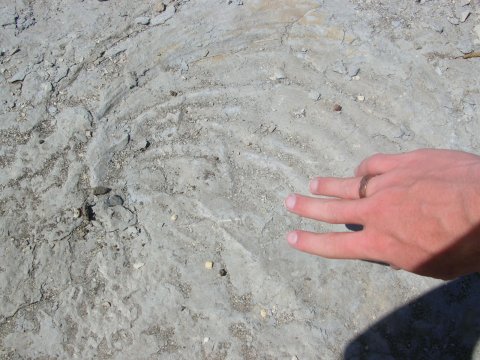
Dallas Paleo's monthly meeting will take place this Wednesday at Brookhaven to take part in a geology class lecture with Brookhaven community college students. I'll also likely be visiting the North Sulphur River just outside of Paris to pick up some Marine Cretaceous fossils and then some. Lastly, here is a picture from my most recent visit to the Xiphactinus quarry in Plano. Found one gi-normous clam in the chalk that was worth a picture too.


Last but not least: Go Dallas Cowboys! Beat dem' Philly Eagles! ;-)

Friday, October 06, 2006

So long Nessie, hello "Monster"

'Monster' fossil find in Arctic
By Paul Rincon
Science reporter, Article from the BBC News

Norwegian scientists have discovered a "treasure trove" of fossils belonging to giant sea reptiles that roamed the seas at the time of the dinosaurs. The 150-million-year-old fossils were uncovered on the Arctic island chain of Svalbard - about halfway between the Norwegian mainland and the North Pole. The finds belong to two groups of extinct marine reptiles - the plesiosaurs and the ichthyosaurs.


One skeleton has been nicknamed The Monster because of its enormous size. These animals were the top predators living in what was then a relatively cool, deep sea. Palaeontologists from the University of Oslo's Natural History Museum discovered the fossils during fieldwork in a remote part of Spitsbergen, the largest island in the Svalbard archipelago. Jorn Harald Hurum, co-director of the dig, said he was taken aback by the sheer density of fossil remains in one area.

"You can't walk for more than 100m without finding a skeleton. That's amazing anywhere in the world," he told BBC News. Dr Dave Martill, a palaeontologist at the University of Portsmouth, UK, commented: "These sites are very unusual. To find that many individuals is a remarkable thing - that's a bonanza."

Ichthyosaurs bore a passing resemblance to modern dolphins, but they used an upright tail fin to propel themselves through the water. Plesiosaurs are said to fit descriptions of Scotland's mythical Loch Ness monster. They used two sets of powerful flippers for swimming and came in two varieties - one with a small head and very long neck, and another with a large head and short neck.

The short-necked varieties are known as pliosaurs. The discovery of a gigantic pliosaur, nicknamed The Monster, was one of the most remarkable discoveries of the expedition. Its skeleton has dinner-plate-sized neck vertebrae, and the lower jaw has teeth as big as bananas.
The skeleton is not yet fully excavated, but its skull is about 3m long, suggesting the body could be more than 8m from the tip of its nose to its tail.

"What's amazing here is that it looks like we have a complete skeleton. No other complete pliosaur skeletons are known anywhere in the world," said Dr Hurum.

The researchers even found evidence of an attack on one of the creatures. An ichthyosaur tooth is embedded in a neck vertebra from one plesiosaur belonging to the genus Kimmerosaurus. The fossil hoard comprises 21 long-necked plesiosaurs, six ichthyosaurs and one short-necked plesiosaur. The bones were unearthed in fine-grained sedimentary rock called black shale.

"Everything we're finding is articulated. It's not single bones here and there, and bits and pieces - these are complete skeletons," said Dr Hurum.

After death, the carcasses came to rest in mud at the bottom of the deep ocean, where little or no oxygen was present. Dr Hurum said an unusual chemistry of the mud could have been responsible for the remarkable preservation of the specimens: "Something happened with the chemistry that's really good for bone preservation. Some skeletons are pale white even though they're in black shale - they look like 'roadkill'."

The marine reptiles found in the Norwegian archipelago are very similar to ones known from southern England. Dr Hurum said the animals could have been living in the same ocean and he now plans to compare the Arctic finds with those from Britain. The Svalbard excavation was led by Dr Hurum and Hans Arne Nakrem, also of Oslo's Natural History Museum. The museum plans to return to the field site in the summer of 2007 to resume excavations.

Monday, September 25, 2006

Yet another... dinosaur article

Subway Sleuth Clears Dinosaur of Cannibalism
John Noble Wilford
September 26, 2006

Full Article on The New York Times online

A graduate student in paleontology was standing on the downtown subway platform at the American Museum of Natural History stop. He idly inspected the bronze cast on the wall of one of the museum’s dinosaurs.


The student, Sterling J. Nesbitt, was surprised to see what looked like crocodile bones that had presumably been the dinosaur’s last feast. This set in motion a re-examination of two specimens on display in the museum’s Hall of Dinosaurs, and wiped clean a dinosaur’s reputation that had been besmirched by suspicions of cannibalism.

Museum paleontologists found that the exhibited predatory dinosaur, Coelophysis bauri, had in fact not eaten one of its own. “Our research shows that the evidence for cannibalism in Coelophysis is nonexistent,” Mr. Nesbitt said in an interview, “and the evidence for cannibalism in other dinosaurs is quite thin.”

In one of the two suspected specimens, the bones of the dinosaur’s last meal, lying inside the skeleton where its stomach would have been, were not those of a juvenile Coelophysis or any other dinosaur. The review showed the bones were of a small crocodile. “The femur was the key,” Mr. Nesbitt said. “I knew this wasn’t a dinosaur that had been eaten.”

The re-examination of the second fossil specimen disputed the assumption that the bones in the stomach area of a Coelophysis were of a cannibalized young dinosaur. The scientists said the bones were outside the dinosaur’s ribcage, and from an animal perhaps too large to have been eaten whole.

The verdict of not-guilty of cannibalism was delivered last week in the journal Biology Letters of the Royal Society of London. The lead author is Mr. Nesbitt, a doctoral student at Columbia and the museum.The two Coelophysis specimens were excavated in New Mexico in 1947 by a dinosaur-hunting party from the museum. The bones that appeared to lie within the dinosaurs’ bodies led Edwin H. Colbert, a museum paleontologist in those days, to assume these animals had been cannibals.

Mark A. Norell, the museum’s curator of paleontology and a co-author of the report, said, the new research was a reminder that it is not always necessary to go all the way to the Gobi Desert to learn something new about dinosaurs. For his part, Mr. Nesbitt said: “It’s pretty lucky. It was an example of serendipity.” And, he added, it helped to be alert while waiting for the subway train.

Friday, September 22, 2006

New links added

Two new links have been added to the "Old Stuff links" column on the right hand side of the blog.

Ashfall Fossil Beds State Historical Park

Wheeler shale Trilobites (a.k.a. U-Dig fossils outside of Delta, Utah)

Finding Lucy's great-grandmother

Remains of earliest child discovered
Article published on the ChinaDaily website

LONDON - A 3.3 million-year-old skeleton of the earliest child ever found shows the ancient ancestor of modern humans walked upright but may also have climbed trees, scientists said on Wednesday.


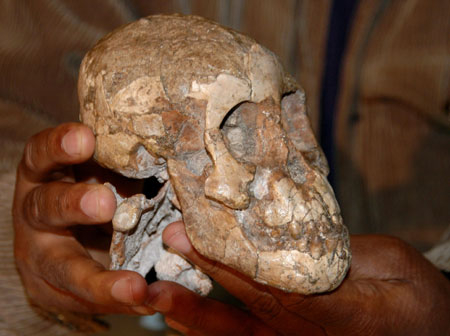
A scientist holds a skull named "Selam" of a fossil discovered in an area of Ethiopia called Dikika, September 20, 2006. A 3.3 million-year-old skeleton of the earliest child ever found shows the ancient ancestor of modern humans walked upright but may have also climbed trees, scientists said on Wednesday.

They found the well-preserved remains of a three-year-old girl of the species Australopithecus afarensis -- which includes the fossil skeleton known as "Lucy" -- in the Dikika area of Ethiopia, 400 kms northeast of the capital Addis Ababa.

"It represents the earliest and most complete partial skeleton of a child ever found in the history of paeleoanthropology," said Dr Zeresenay Alemseged, of the Max Planck Institute for Evolutionary Anthropology in Leipzig, Germany.

The skull, torso and upper and lower limbs, including the hand,
show both human and ape-like features. The state of the ancient bones suggest she was buried in a flood which may also have caused her death. The remains provide the first evidence of what babies of early human ancestors looked like. The nearly complete skeleton will also provide information about the child's height and structure.

"This child will help us understand a lot about the species to which it belongs," said Alemseged, leader of the international team of scientists who reported the findings in the journal Nature. "The lower part of the body, which includes the foot, the shin bone and the thigh bone clearly shows us that this species was an upright walking creature," he told Reuters.

But some of the features from the upper part of the body, incl
uding the shoulder blade and arms are more ape-like. The fingers are long and curved which suggest she might have been able to swing through trees.


"The finding is the most complete hominid skeleton ever found in the world," Zeresenay Alemseged, who is head of the Paleoanthropological Research Team, told a news conference in Addis Ababa. He said the fossil was older than the 3.2-million-year-old remains of "Lucy" discovered in 1974 and described by scientists as one of the world's greatest archaeological finds.

"The new bones belong to a three-year-old girl who lived 3.3 million years ago, 150,000 years before Lucy," Zeresenay said. The fossil has been named "Selam," which means peace in Ethiopia's official Amharic language. Dr Simon Underdown of Oxford Brookes University in England described it as a massively exciting discovery of a juvenile "Lucy." "This tremendous fossil will make us challenge many of the ideas we have about how and why we came to walk on two feet," he said.

An analysis of the sediment in which the remains were found enabled researchers to build a picture of the type of environment in which the child lived. It was a lush area with flowing water, forests and grassland which was also affected by volcanic eruptions. The range of habitats was suitable for hippos, crocodiles and relatives of the wildebeest.

"We can see from the sediment that the region was very much characterized by a mosaic of environment that ranged from forests and woodlands near the rivers, to seasonally flooded grasslands to a flood plain that would have supported more open vegetation," said Dr Jonathan Wynn of the University of South Florida who dated the sediments surrounding the remains.