The September auction meeting for the Dallas Paleontological Society was, in my humble assessment, a great accomplishment. Ninety items ranging from fossil cabinets, outdated library books, miscellaneous fossils collections down to a single metal detector. I was particularly interested in a field guide book with choked full o illustrations and photographs of mineral and fossil specimens. I also came away with several other knickknacks including other books and small marine, invertebrate fossils. I had a great night at the auction.
I was also wished a happy date-late 17th birthday by Brian and the rest of the society.
Thanks all.
Thursday, September 14, 2006

Tuesday, September 12, 2006
Saturday, September 09, 2006
The Crocodile Hunter
Steve Irwin
22 February 1962 – 4 September 2006
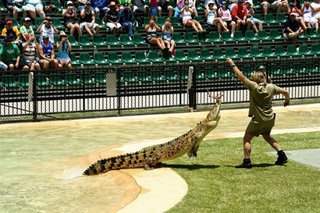 You will be missed mate... but not forgotten.
22 February 1962 – 4 September 2006
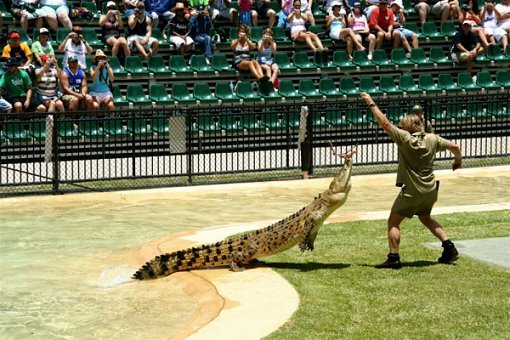 You will be missed mate... but not forgotten.
Lack of decent time for post
Please pardon me for my lack of relatively recent post. School has since started and has pinned me down with all sorts of work for the year ahead. I promise more post will come soon with the passing of this semester. Remember that this is my junior year and so I will be posting more updates on my college search. I will also participate more with the Dallas Paleontological Society, hopefully putting in more pictures of field trips and society meetings as they come and go.
Until then...

Until then...
Saturday, September 02, 2006
Brazil's big baby
Brazil's Biggest Dinosaur
This week Maxakalisaurus Topai went on display in Rio de Janeiro
Ana Maria Brambilla
Article from OhMyNews
The Brazilian paleontologist Alexander Kellner is a dinosaur hunter. His latest treasure is a specimen that is some 80 million years old. Officially named "Maxakalisaurus Topai," Kellner's dinosaur is the 16th prehistoric animal discovered on Brazilian ground. After four years of research and preparation, the dinosaur is now on display at the National Museum of the Federal University of Rio de Janeiro.
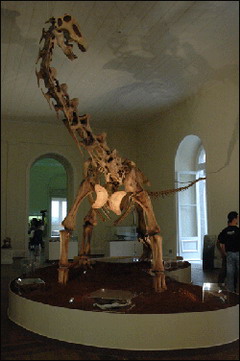 © 2006 Alexander Kellner
"Seven researchers were involved. For the technical aspects, more than 15 volunteers, students, paleoartists and technicians pitched in," Kellner said.
This is the biggest dinosaur ever discovered in Brazil. Its weight is about nine tons and it measure about 13 meters in length. Maxakalisaurus Topai lived on land in the middle of Brazil, in a region called Triangulo Mineiro. On completing the research, many people were excited about the idea of seeing the dinosaur completely mounted.
"Boyfriends and girlfriends of the technical team were involved, as well as many volunteers that fell in love with the project and helped us to realize it," Kellner said.
Even the paleontologist's children participated in the expeditions. His boys, Alexandre, 13 and Guilherme, 11, followed their father to Minas Gerais state where Maxakalisaurus Topai was found. In an interview with a Brazilian magazine, Kellner said he wanted to teach his children respect and to know the importance of paleontology. Speaking to OhmyNews this week, Kellner said that the repercussions of this discovery inside the scientific community are enormous.
"We have just discovered a new species, contributing to a better understanding about dinosaurs from a part of the world where scientists still know very little," he said.
Maxakalisauros Topai is a dinosaur closely related to the Saltasaurinae, an evolved group of dinosaurs with long tails, small skulls and voluminous bodies. Cleaning the skeleton, removing layers of sediments and encasing all the parts took Kellner and his team more than three years. Part of this job began when they were still digging the bones out of the ground. It took 18 months to assemble the bones and then a further 30 days to prepare the exhibition hall.
Some of the bones have tooth marks on them, which leads scientists to conclude that the dinosaur may have been gnawed on by carnivores after its death. In Kellner's opinion the exhibition of Maxakalisaurus Topai is a landmark in Brazilian paleontology that will attract attention from researchers worldwide. The National Museum is now running a competition among children to let them choose a nickname for Maxakalisaurus Topai.
This week Maxakalisaurus Topai went on display in Rio de Janeiro
Ana Maria Brambilla
Article from OhMyNews
The Brazilian paleontologist Alexander Kellner is a dinosaur hunter. His latest treasure is a specimen that is some 80 million years old. Officially named "Maxakalisaurus Topai," Kellner's dinosaur is the 16th prehistoric animal discovered on Brazilian ground. After four years of research and preparation, the dinosaur is now on display at the National Museum of the Federal University of Rio de Janeiro.
© 2006 Alexander Kellner"Seven researchers were involved. For the technical aspects, more than 15 volunteers, students, paleoartists and technicians pitched in," Kellner said.
This is the biggest dinosaur ever discovered in Brazil. Its weight is about nine tons and it measure about 13 meters in length. Maxakalisaurus Topai lived on land in the middle of Brazil, in a region called Triangulo Mineiro. On completing the research, many people were excited about the idea of seeing the dinosaur completely mounted.
"Boyfriends and girlfriends of the technical team were involved, as well as many volunteers that fell in love with the project and helped us to realize it," Kellner said.
Even the paleontologist's children participated in the expeditions. His boys, Alexandre, 13 and Guilherme, 11, followed their father to Minas Gerais state where Maxakalisaurus Topai was found. In an interview with a Brazilian magazine, Kellner said he wanted to teach his children respect and to know the importance of paleontology. Speaking to OhmyNews this week, Kellner said that the repercussions of this discovery inside the scientific community are enormous.
"We have just discovered a new species, contributing to a better understanding about dinosaurs from a part of the world where scientists still know very little," he said.
Maxakalisauros Topai is a dinosaur closely related to the Saltasaurinae, an evolved group of dinosaurs with long tails, small skulls and voluminous bodies. Cleaning the skeleton, removing layers of sediments and encasing all the parts took Kellner and his team more than three years. Part of this job began when they were still digging the bones out of the ground. It took 18 months to assemble the bones and then a further 30 days to prepare the exhibition hall.
Some of the bones have tooth marks on them, which leads scientists to conclude that the dinosaur may have been gnawed on by carnivores after its death. In Kellner's opinion the exhibition of Maxakalisaurus Topai is a landmark in Brazilian paleontology that will attract attention from researchers worldwide. The National Museum is now running a competition among children to let them choose a nickname for Maxakalisaurus Topai.
Subscribe to:
Posts (Atom)
